Saturday, February 27, 2010

Haruko Okano

Haruko Okano is a 3rd-generation Japanese sculptor/installation artist from Vancouver, B.C. Her work combines her 'spiritual beliefs' with her love of the land. Her installations are viewer interactive and combine commercially produced natural products with dead/decaying plant material. Her work has been exhibited from the local to international level.

Below is an installation named Assalt from Haruko that uses
evaporation and conduction of salt water. It is based on the relationship of salt to human biology and the human history of salt use. Human blood is 6% salt. Salt is a necessary mineral in our diet yet at the same time, too much salt is toxic. Salt is also used to preserve foods, and was used as a means of mummification in Egyptian history. I appreciate Haruko's innovative ways of using natural products in her work to create original pieces of art.


Friday, February 26, 2010

Giuseppe Penone

"Through both his analytical and sensorial approach, he takes us to another vision of our physical world, and emphasizes the existing link between human being and mother nature."

Giuseppe Penone is an Italian artist who became part of a movement called Arte Provera in the 60's.  Since then, he has used many materials to create his art that are considered relatively unconventional - such as wax, wood, and natural elements like the rain and sun.  Penone is extremely interested in nature and the body and, through his art, conveys the beauty of our natural environment and its connection to the body.

In Penone's 1968 work titled Alpi marittime: Albero, filo di zinco, piombo (Maritime Alps: Tree, zinc wire, lead), shown below, he traced his hand and arm and embedded wire into the bark of a tree.  The idea is that the tree would adapt and grow around and with the material.


In possibly his most famous work, titled Rovesciare i propri occhi (To reverse one's eyes), 1970, Penone is shown in a photograph, wearing custom-made mirrored contact lenses.  In this piece, the experience seems far more pertinent than the actual recorded work.  The experience allowed Penone to experience himself more objectively, to reflect on himself, to look inward.

Conceptually, all of Penone's work is intriguing - because of his thought process, his materials process, and his mindset.  That said, I find some of his artworks, which are less directly related to the body, visually far more interesting.

"Rise of the wood, of the forest, rise trees of the orchards, of the avenues, of the gardens, of the parks, rise from the wood that you have formed, take us back to the memory of our lives, tell us about the events, the seasons, the contacts of your existence.  Take us back to the woodland, the darkness, the shadow, the scent of the undergrowth, the wonder of the cathedral that is born in the wood land." 
-Giuseppe Penone, 1979

Sources:
http://www.exporevue.com/magazine/gb/penone_beaubourg_angl.html
http://www.museomadre.it/bio_show.cfm?id=67
http://www.allisonhunter.com/Art/penone.html
http://www.mariangoodman.com/artists/giuseppe-penone/

Thursday, February 25, 2010

Andrew Rogers


Andrew Rogers is an internationally recognized sculptor from Austrailia. His piece, called "Rhythms of Life", is the largest land art sculptor in the world. The pieces, called Geoglyphs, are in 12 countries and 5 continents. Over 5,500 people helped created these works.


Wednesday, February 24, 2010

Blood Puddle Pillow


The blood puddle pillow created by The Great Slumber creates a creepy illusion as if you are bleeding from your head. If you type in "blood puddle pillow" you will find lots of results with some of these images and descriptions about the product. Where would you buy one you wonder? Who knows, even with so many Google results, I was still unable to find where one might purchase this creepy product.

Even so this was one of the things that inspired my crime scene body extension. Enjoy :)

Monday, February 22, 2010

Beverley Semmes


Beverley Semmes is an artist who creates a very diverse range of work that incorporates several different aspects including sculpture, textiles, time based, and site specific art. The works that Semmes creates that are most connected to the body are costumes that elongate to create large scale shapes of fabric. In some instances these costumes are simply displayed hanging in a gallery while others are captured in photograph being worn by a subject. Semmes incorporates performance into the photographs by choosing sites that form a connection to the costumes and creating narratives. Through her costumes Semmes provides social commentary about issues of the body and feminine image.

Cornelia Walking in the Formal Garden in the Pink Feather Coat and Hedge Hat
1988

This image is a still from a film that Semmes made of a friend wearing one of her costumes. The film was made in the garden of a psychiatric hospital where Semmes was living and working. The coat was made from window screening and pink feathers. Semmes idea was to create a costume that would make the wearer become a part of the garden.

Wednesday, February 17, 2010

Mathew Barney


I am trying to make sense of this too.

Little Big Planet based on Matthew Barney’s Cremaster Cycle

In ARTEfacts, EROtonauten, PERFORMING arts, vaya PERSONajes on AbrpmTue, 21 Apr 2009 22:46:15 +00002009-04-21T22:46:15+00:0010 28, 2008 at 10:28 p04

here is mucch more to comeT

Lucy Mcrae and Bart Hess

"LucyandBart" is a collaboration between two artists Lucy Mcrae and Bart Hess. they describe there works as stalking fashion, architecture, performance and body.


In it they imagine human bodies and faces physically altered with a shocking but artistic realism. Creating a fascination with beauty expression and genetic manipulation. For example, the disturbed, electric-skinned, light-headed, border of nausea kind of way. To me, each transformed human looks either horrified or surprised or excited about their change of form. Yet these weird sorts of artistic mixing, which I found the colors are beautiful, but the shapes are unusual, are really jarring that make me feel creepy. I guess it’s the kind of imperfections and oddities that society mutated human shapes. According to Lucy and Bart, they stated that "They work in a primitive and limitless way creating future human shapes, blindly discovering low – tech prosthetic ways for human enhancement."


Janaina Tschape


All this happens in Tschäpe’s work. Synthetic materials and natural settings, oneiric sequences and factual occurrences,
painterly deployments of space and kinetic use of compositional elements—these are the antithetical lines that twirl, in her work, into
complicated braids of meaning and action, and ultimately coalesce into densely operatic images

Gean Moreno, 2004
Born in Germany Janaina Tschape currently works between Brazil and New York. Her work has an international language with a wide appeal. Recognized for her baroque sensibilities, Janaina is known for transforming the female body in a variety of ways. She takes a human model and extends their body with fin and tentacle like fabric, bulbous condoms and a myriad of other extensions that tie the body to nature while divorcing it from reality. To combat the ephemeral nature of her work her shows include High Definition video projection, a digital video on wall-mounted plasma screen,Cibachrome photographs, watercolor drawings, lithography and photogravure. Though some of her work is quite serious there is a tongue in cheek feeling to other pieces: her Naiad series was shot in Weeki Wachee Springs, Florida, home of the fabulously campy Weeki Wachee Mermaids.

Lygia Clark


As you saw in class on Monday Lygia Clark was able to make body extensions from the eyes-goggle looking contraption that allows you to look into anothers in a whole new way. The interesting thing about her is she was able to create a "body extension" but it also allows toy to interact with others. She was unique for this, and was always trying to include interaction with artwork.
She was from Brazil, and was determined to explore the distance between the body-and space. I found a lot of pictures of her work, but it was difficult to find good descriptions to go with the pictures.
p.s The picture above on the left reminds me of the KKK mixed with an alien.

Tuesday, February 16, 2010

Louise Bourgeois

louise-bourgeois-2-from-the-san-francisco-chronicle.jpg

Louise Bourgeois is best known for her Cells, Spiders, and various drawings, books and sculptures. Her works are sometimes abstract and she speaks of them in symbolic terms with the main focus being "relationships" - considering an entity in relation to its surroundings. Louise Bourgeois finds inspiration for her works from her childhood: her adulterous father, who had an affair with her governess (who resided in the home), and her mother, who refused to acknowledge it. She claims that she has been the "striking-image" of her father since birth. Bourgeois conveys feelings of anger, betrayal and jealousy, but with playfulness. In her sculpture, she has worked in many different mediums, including rubber, wood, stone, metal, and appropriately for someone who came from a family of tapestry makers, fabric. Her pieces consist of erotic and sexual images and also forms found in nature, such as her sculpture, Cumuls (referring to clouds in the sky) and Nature Study. Although she has worked with spider imagery since the 1940s, perhaps her most famous works are the spider sculptures from 1994 to 2003. This includes her most famous sculpture, Maman.

bourgeois-cumul1.jpgseveninbed.jpg

bourgeois-maman-natgallery.jpg


kosoke tsumura


has anyone read or seen the road? kosoke tsumura is equipping us for a much more ornate end. his clothing lable, Final Home, feeds from the aftermath of disaster and having to exist in the ashes of cities or in a more natural world. he has made jackets with up to 40 zip pockets intended for different purposes such as holding insulation, food, and supplies.

here is a brief description of one of the pieces from his website. it didn't translate so well. you should read it.

"Appearance is available as a zip pocket, open and close the gap between the body back of the fabric is coated with a flat table cloth,
Weir is almost like the ultimate home.
You can also use it as a large number of photographers jacket pocket.
Things can also wear away at Oke put security and safety emergency goods can be protected in the pocket of the body to put the sponge in the head with a hood portion of disasters.
Tidibea cushion and will also put the cushion down jacket is also dedicated to healing!
I can use it as weight training and Serufudifensuuea.
Excursions and walking and also serves as the bag.
Ecological survival also wear insulating effect can be obtained and put it round and finished reading newspapers and magazines."

not everything he does centers around this sort of survival root. above are pictures from an installation called "cocoon cradle and mother" in which he designed a single shape to be duplicated and linked together. the material is made from a non-woven fabric called felibendy.

Jana Sterbak by Katie Scoville

Sterbak's works are primarily driven by issues of power, sexuality and control. Also, she explores the relationship between humanity and technology.

A more disturbing piece I found of hers is a very clear example of power, sexuality and control. In this image we see a model wearing a dress made of meat.

In 1991 Sterbak caused quite the debate at the National Gallery in Ottawa, Canada by hanging 50 pounds of raw flank steaks stitched together in the form of a dress on display. Supposedly this was to emphasize the contrast between vanity and bodily decay. As it moved from all sort of galleries through the U.S and Europe the meat was replaced every six weeks when the meat would decompose with $260 worth of fresh meat.

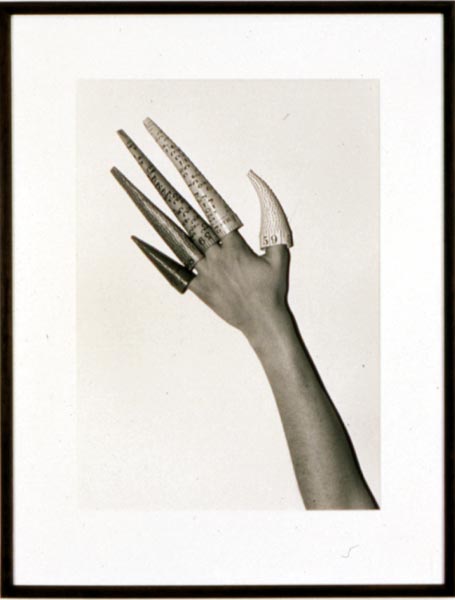
Another piece I would really like to share that deals with body extensions is this one. Though I'm having the hardest time finding more information about it. All I know is that it is called "cones on fingers" and that each cone is made of measuring tape.


And this is a similar concept but the cone covers the whole hand.


Wish I could have found more information on these. My opinion about the Jana Sterbak is a good one. I found her work to be really interesting. When we were looking at the slides in class one of the images we viewed was the "monumental crutches." In class this piece really stood out to me and I actually went home thinking about this idea of crutches being an extension of the body. Then I did some research and discovered it was this artist. Here is a picture of the "monumental crutches" just as a reminder. I like how simple her ideas are and yet they still shock the viewer and stimulate discussion.

Pat Oleszko

Pat Oleszko does performance art based with costumes and props that she creates. Some inspirations she draws from are burlesque house, parades and magazines such as Sesame Street, Ms. and Playboy. She includes satire and play on words into her work. Some of these pieces are made for her to wear, some include other people and some just stand alone. Her costumes and props are very whimsical, something you’d maybe see in a fairy tale except more perverse. She does use body part extension, many of her costumes or pieces include multiple feet and/or multiple arms.

Her work is very visually appealing, bright colors and large props. I really like the captions that are attached to the pictures of her work, they are quite clever and satire is one of my favorite forms of humor. There are also clips of performances on her website.


img07.jpg


Caption:

Knee-o-fascism

Media Trixie and her Sole-Sistah Wendy Wear-With-All. The New York Times asked a few artist to interpret the Spring Collections. I was a shoe-in candidate. Given the opportunity, I brought fashion -- to its knees


http://www.patoleszko.com/

David Eckard "scribe" piece


David Eckard is one of Portland's most established and respected artists. David Eckard had done different work in sculpture, drawing, and performance. I believe that Scribe is one of the best and most creative works for David Eckard that he have done. “Scribe” looks like a cart, which will help him to easily flip around the city. Also he can easily sit it on the floor by itself. It has three legs that looks like a table. Scribe can easily turn around itself to create circle shapes in the floor. To make it work you just need to lie down on it and start your work with out getting dirty, which make it extra special experience. Personally I like this piece more than any other one that David did. Because, I saw in “scribe” a successful and effective piece.

Ann Hamilton


Ann Hamilton is an artist who works with installations, sculptures, textile art, photography, printmaking and video. Although Ann Hamilton is mostly known for her installation work, she had a series of photos called the untitled body objects series. They originally stared off as ideas for future installations. Some pictures are puns (the image at the center left is a "basket case" or "basket head"), while others use the placement of the objects to create meaning. By using herself as a subject, the untitled body objects became the first piece where Ann Hamilton used a living subject.

PONGOLINI GIUSEPPE


Is an italian sculptor who works mostly in iron. Focusses on the issue of pain and how it relates to society. His sculptures range from being hand size to larger than human size. he likes to contrast iconic elements to enhance the definition of pain. He looks to focus on conceptual expressionism and often enjoys being contraversial. he started with chairs and talbes so that people would realize the conflict with everyday items.

Ernesto Neto

Ernesto Neto is a contemporary Brazilian artist.  He creates large installations, which are often made using thin, stretchy fabrics and encompass entire studio or gallery spaces.  Much of his work is interactive, allowing viewers to interact closely with the pieces of art.

Some of Neto's installations would be considered extensions of the body - allowing viewers to physically interact with the art by sitting or lying on it.

The following images are some of Neto's installations.  I am including works that fit into the body extension genre but also other examples of his work, which I find equally as intriguing.